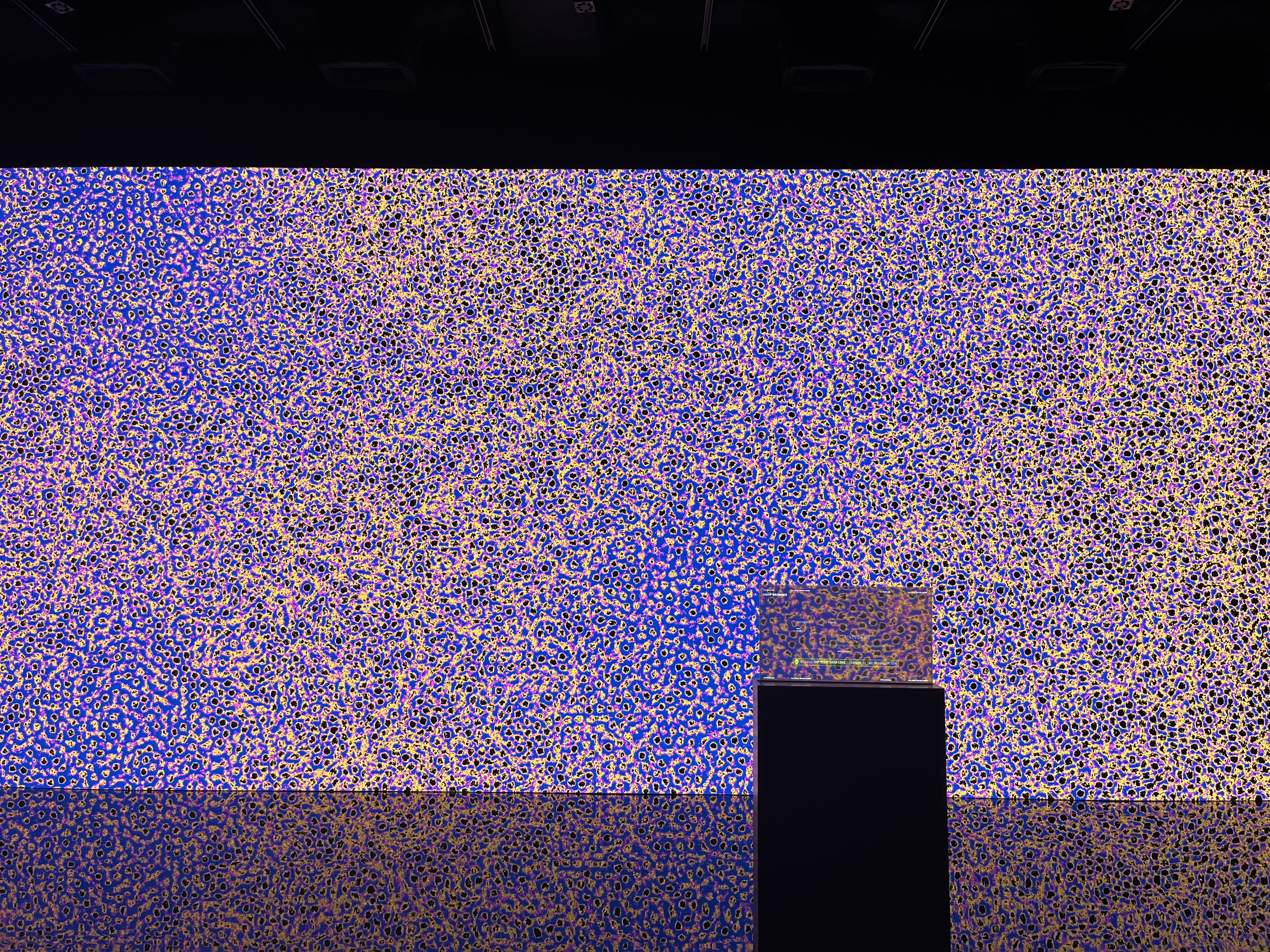
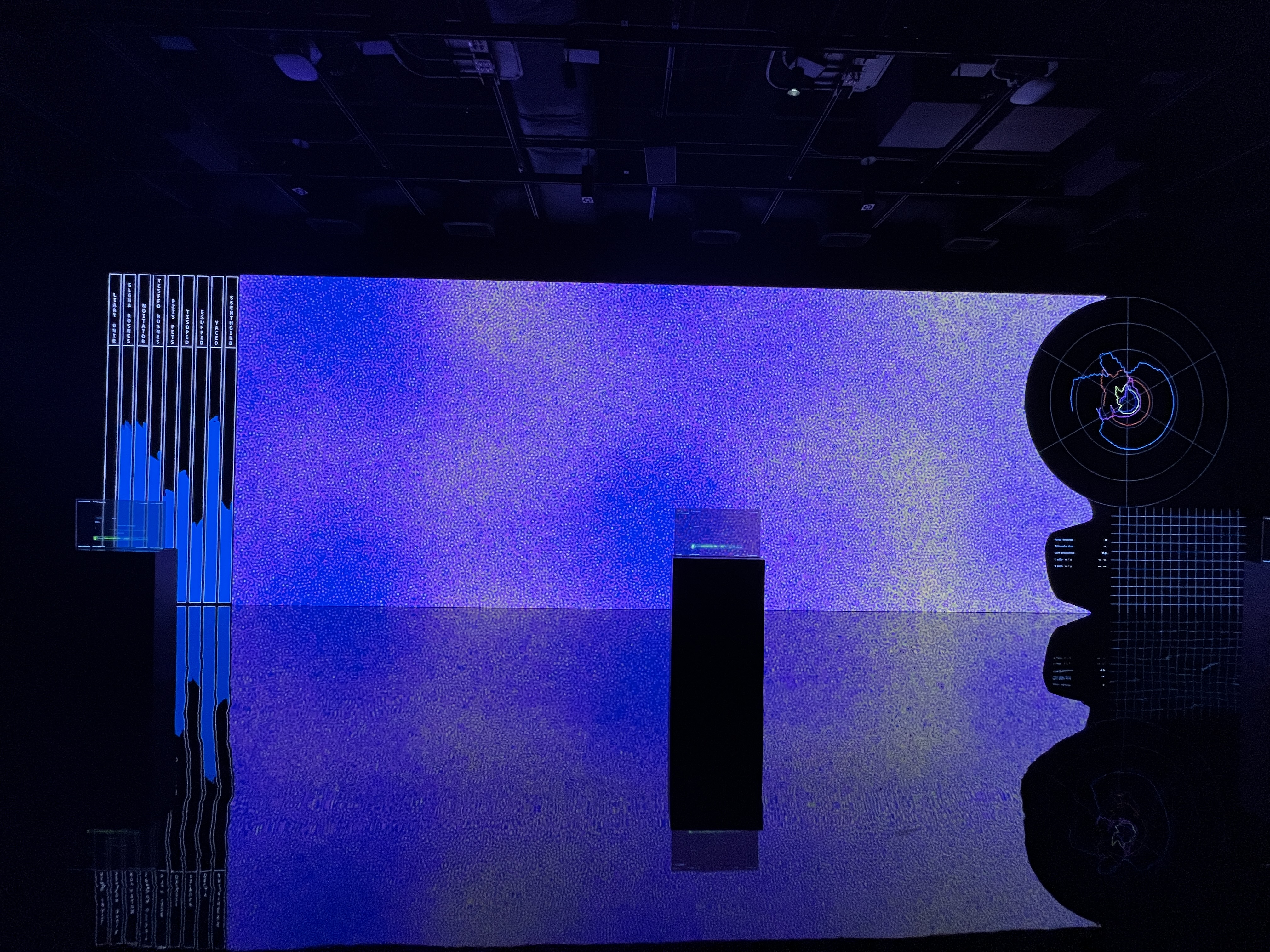
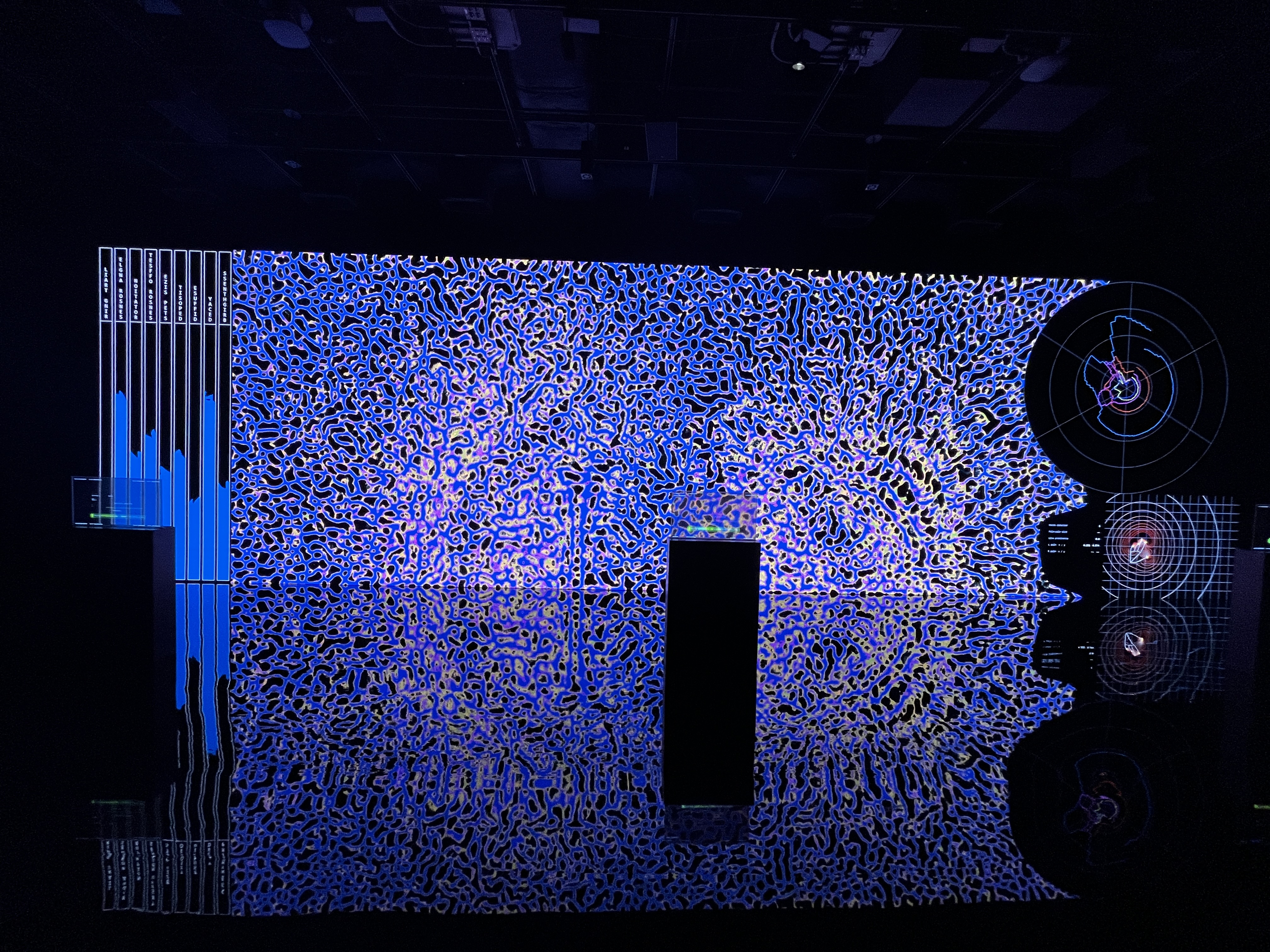
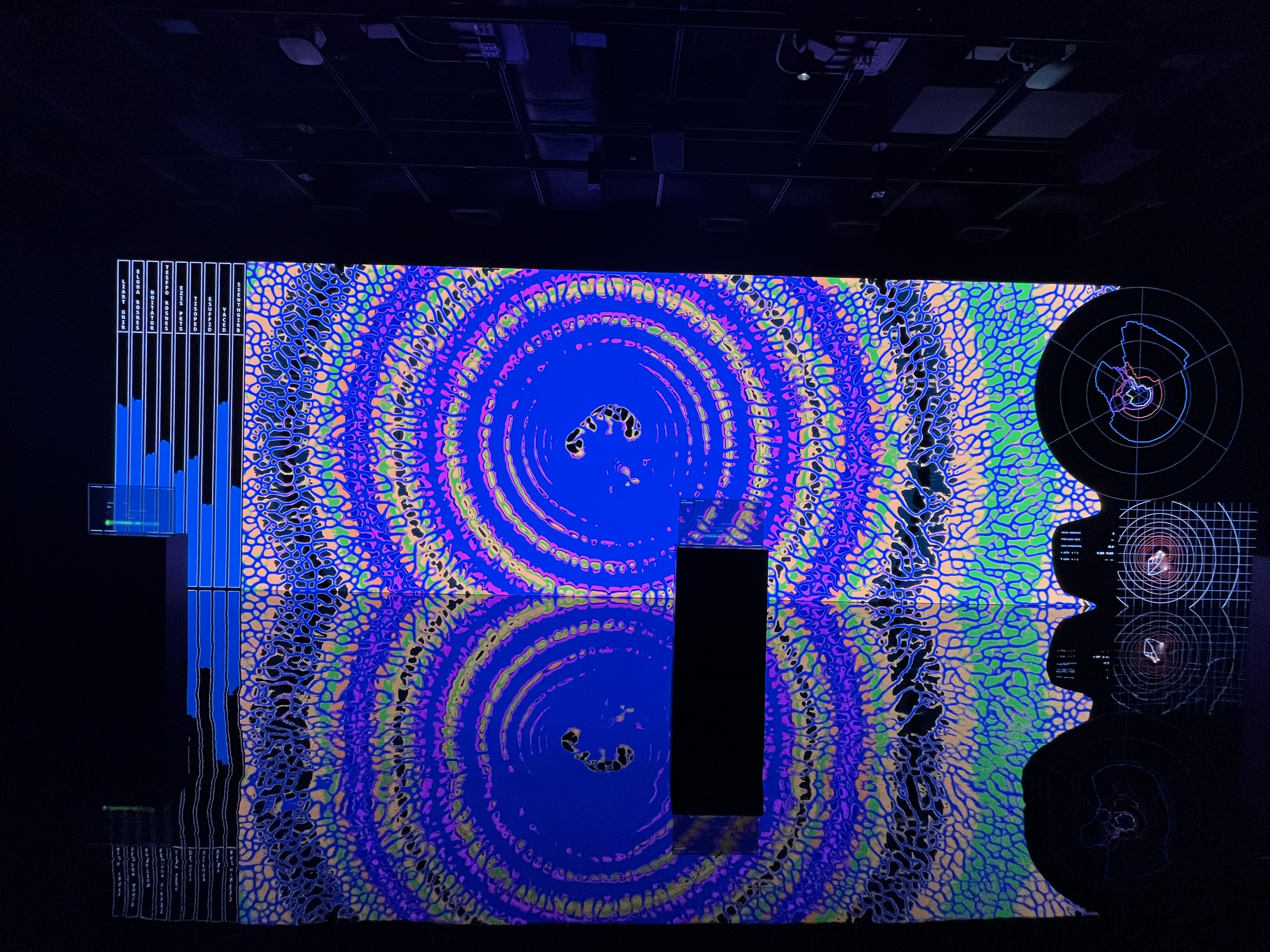
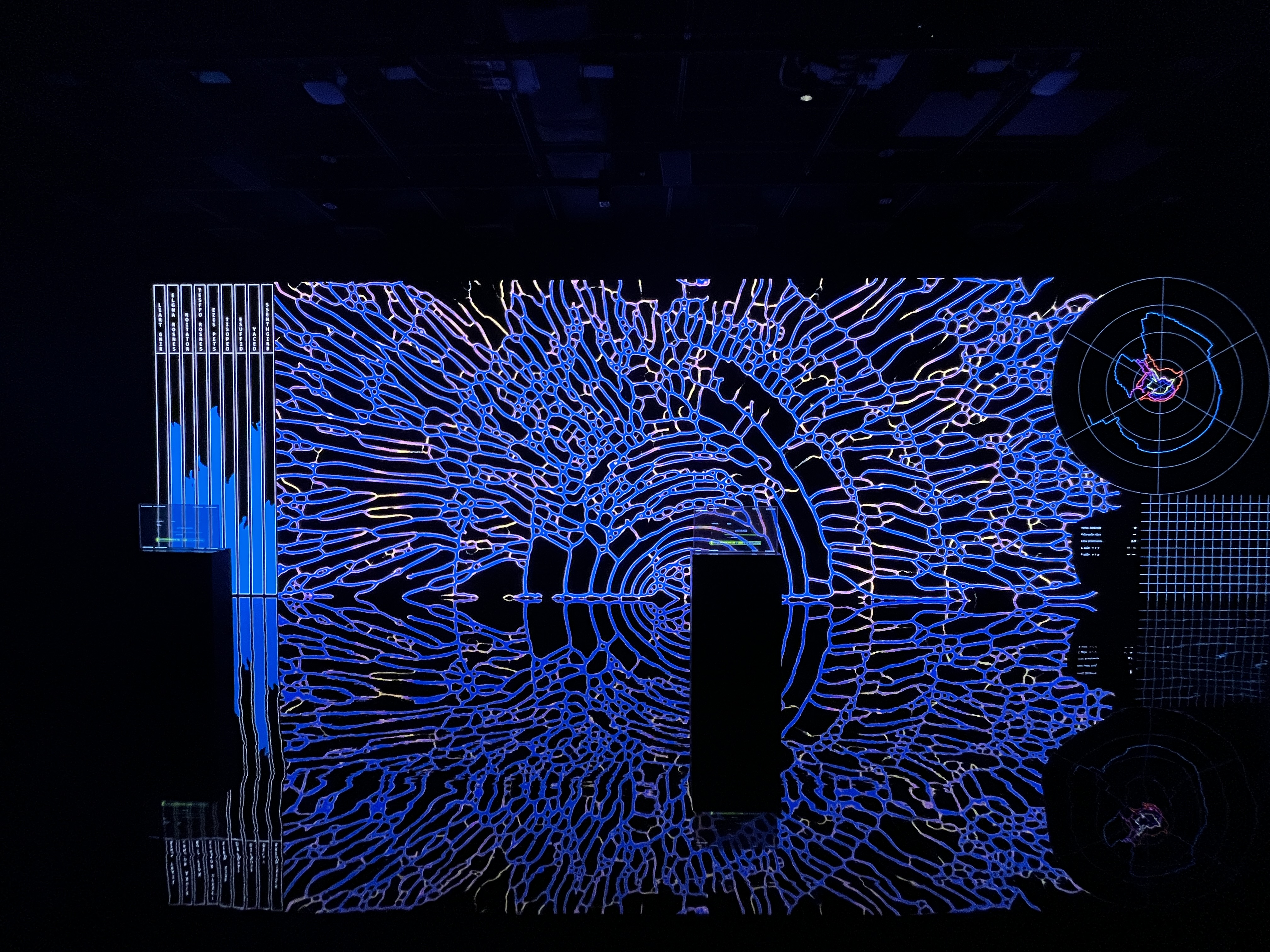
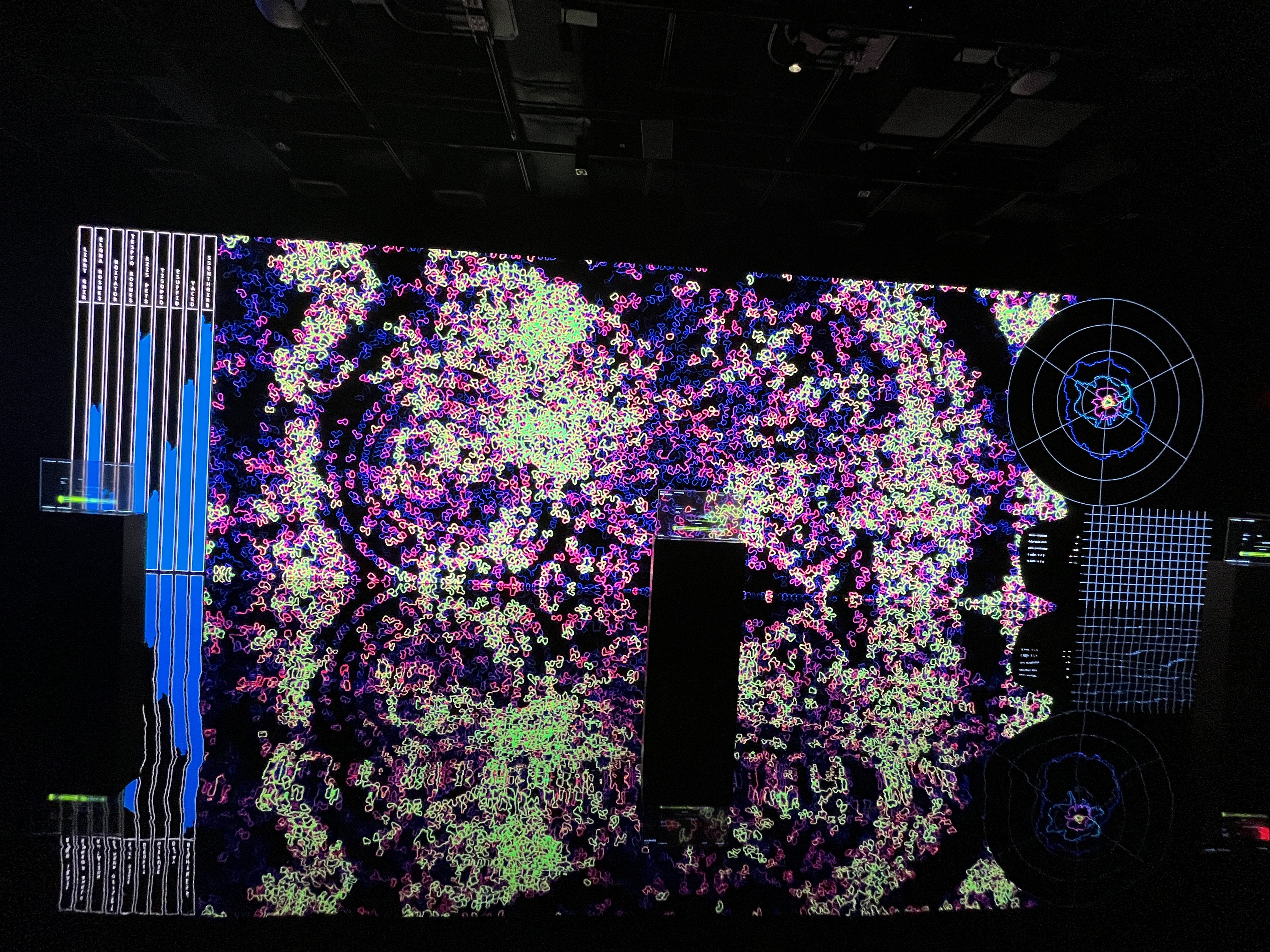
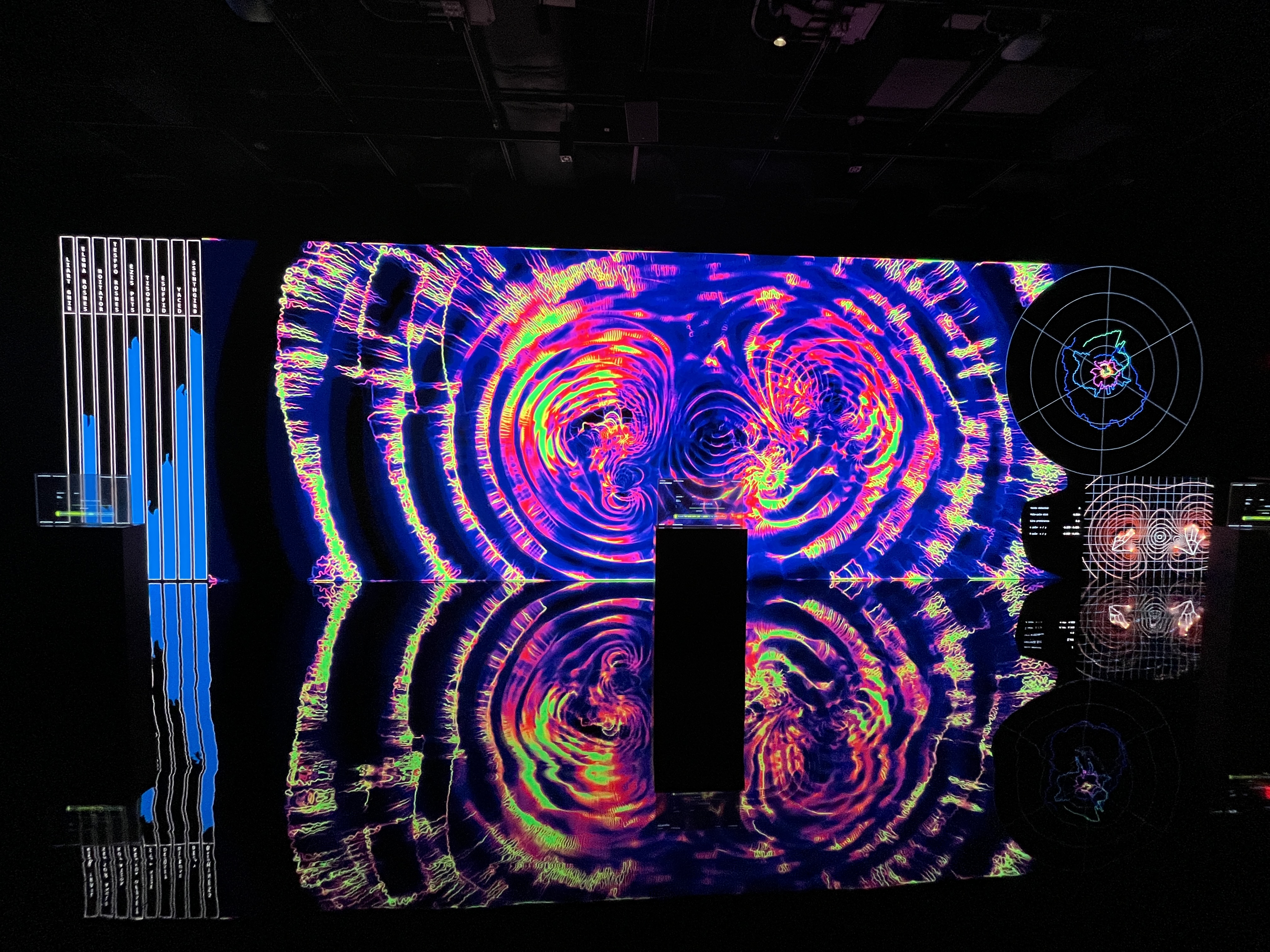
I've had dreams where my ideas were materialized instantly.
It is a beautiful, awe-inspiring feeling that I wanted to share.
Manipulating 'cells' based on real biology by waving your fingers around was the best analog to playing god that I could come up with.
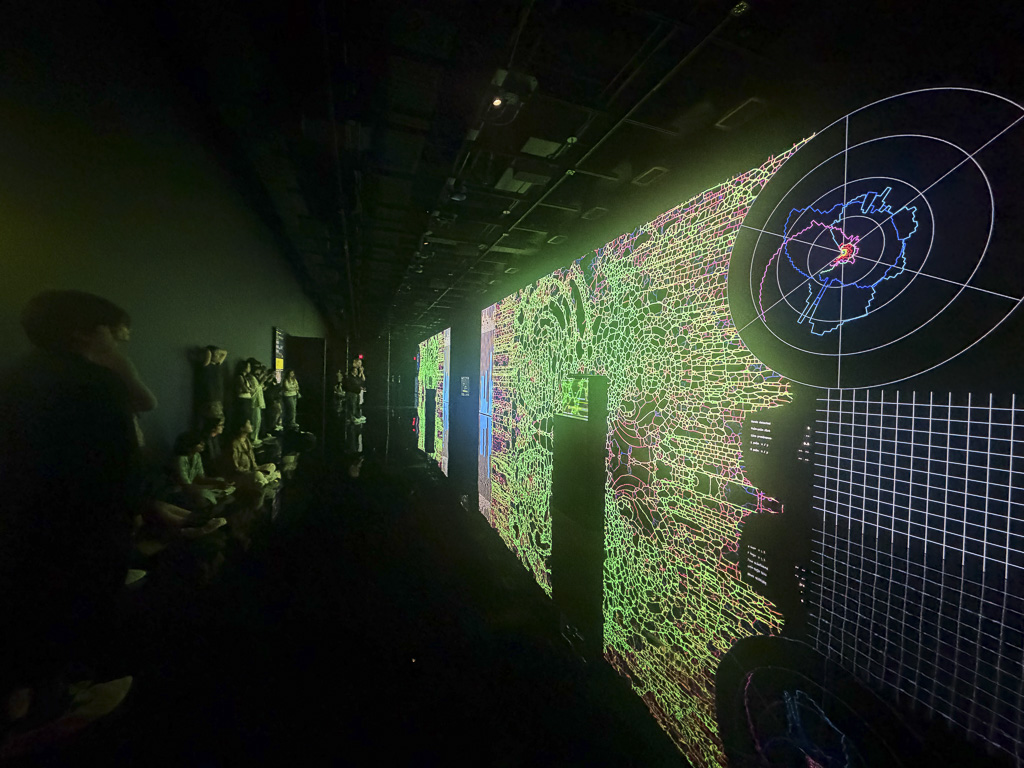
Piece exhibited at Dataland Musuem in Los Angeles, CA.
Created as part of DMA113 - S26 taught by Prof. Refik Anadol.
AI was used in the execution and optimization of this piece, mainly to handle the 160 mB/sec bitrate of the hi-res installation.
To the best of my ability, I worked to prevent any impact the AI's 'choices' had on my creative process, my intentionality, or the piece's visuals.
It is a difficult and slippery slope to meaningfully use AI in art, but it I believe it's worth exploring.
I was initially inspired by artist Sage Jensen's work with particle simulations. Her portfolio website guided me to this paper:
Jones, J. (2010). "Characteristics of Pattern Formation and Evolutionin Approximations of Physarum Transport Networks."
Artificial Life, 16(2), 127-153. doi:10.1162/artl.2010.16.2.16202
The paper provides an explanation of the behavior of Physarum transport networks, otherwise known as slime molds.
It describes a surprisingly simple algorithm for the behavior of each individual cell in the slime mold, which
together form the emergently complex behavior that shapes the visuals of the piece:
The particle has some forwards velocity, and it can sense 'food' at three points relative to its position.
If the particle senses 'food' at any one of the three locations, it will change the angle of its velocity
by some set number of degrees towards where the food was sensed.
The particles will leave a trail of food behind them. This trail of food is how the particles coordinate themselves:
Particles will follow other particles' food trails, creating an emergently complex system that simulates a slime mold's movement.
Parameterizing and manipulating the behavior of these particles allows for beautiful and chaotic variation, guided by the fingertips of the viewer.
Here are some clips of several potential variations.
Apologies for the web-necessitated low bitrate. It crushes most of the detail, but the larger patterns are still visible.
If the clips aren't playing, click on the right part of the screen and scroll back to the top of the page. They should play the next time they're on-screen.